
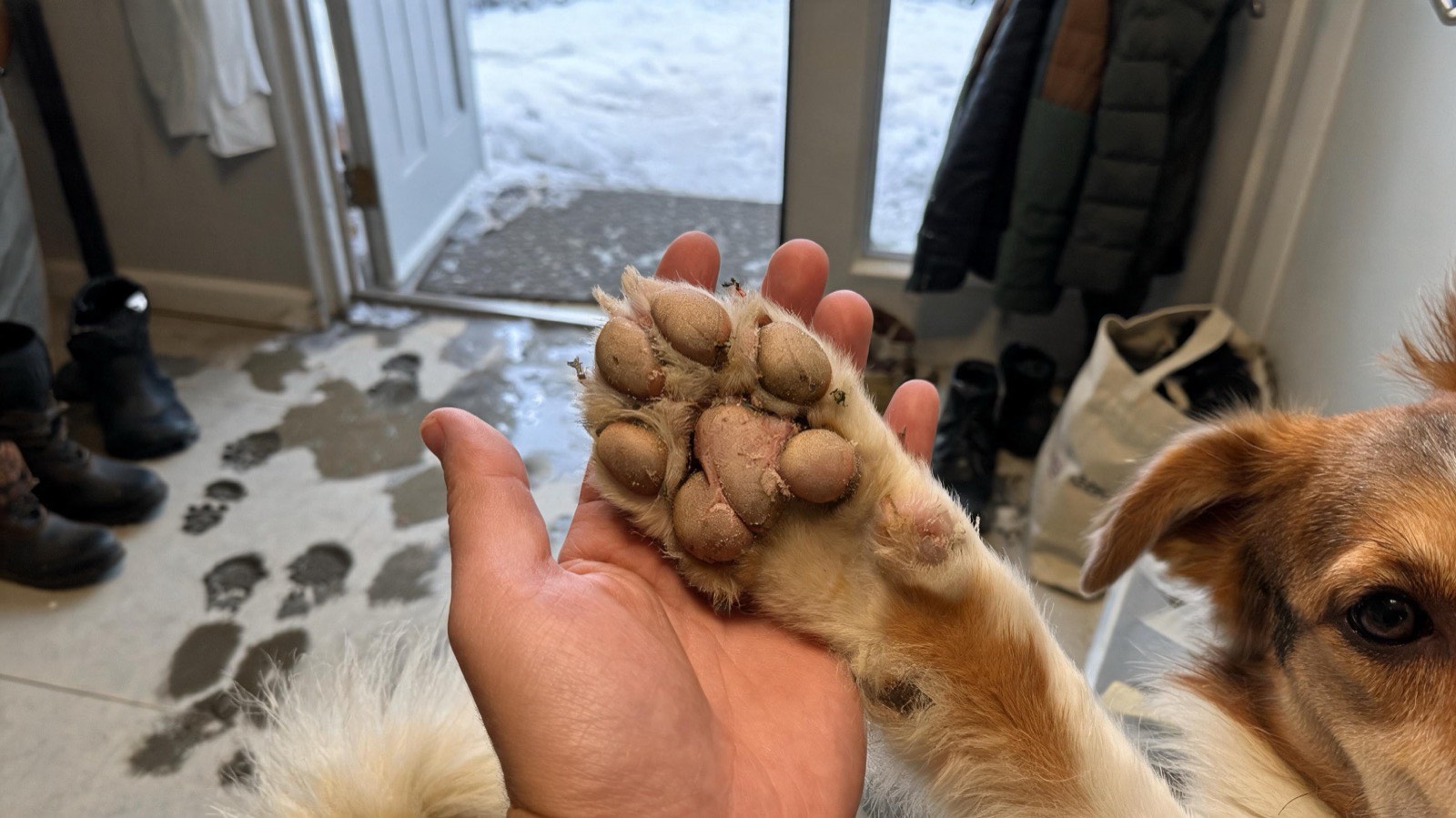
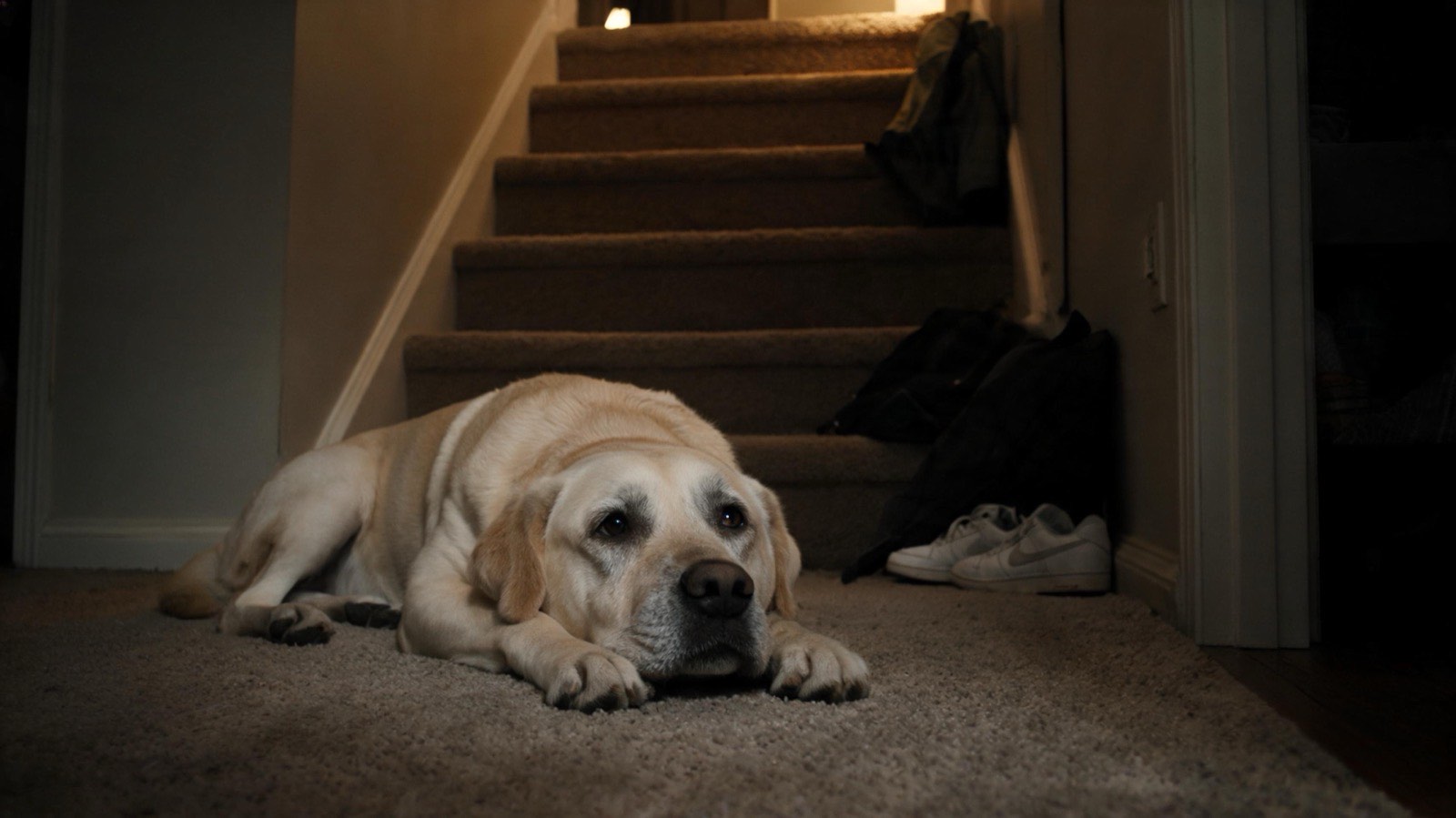
Birdie started licking her right front foot at nine forty at night, on the rug, with that focused wet sound that means something is wrong. We'd been home two hours. The walk had been fine. She trotted the whole loop down Woodward and back past the school like she owned the block.
By ten the webbing between her middle toes was pink and shiny and she would not leave it alone.
That gap between the walk being fine and the rug not being fine took me an embarrassing number of winters to work out, and I do this for a living.
What is actually on the sidewalk
"Salt" is doing a lot of work as a word. Four different things go down on a Portland sidewalk during an ice week and they don't behave the same.
Rock salt is sodium chloride and it quits near fifteen degrees. Below that people reach for calcium chloride, which keeps working in brutal cold by giving off heat as it dissolves. Magnesium chloride sits in the middle. Then the urea and acetate blends, the bags with a dog on the front.
Pet safe is a marketing phrase, not a regulated one. Those blends really are less abrasive, and they're worth paying for on your own steps. They do nothing about your neighbor's steps, which is where your dog walks.
Half the problem isn't chemistry anyway. Rock salt crystals are sharp and irregular, and they wedge up into the webbing between the toes, where the skin is thin and a dog can't shake them loose. A dog can walk a mile on a pad. The webbing wants no part of it.
Why it shows up two hours later
Cold feet don't report much. Blood flow to the extremities drops and sensation goes with it, the same reason you can scrape a knuckle in January and only find out about it in the car. Calcium chloride is also hygroscopic. It pulls water toward itself, out of skin included.
So she walks through it and feels nothing. Then you come home. The foot warms up on the rug over ninety minutes. Circulation returns. Now she feels it.
And then the licking makes it worse, because saliva keeps damaged skin soft and soft skin tears. A lot of the raw feet I see in January are self-inflicted.
The tub by the back door
The most useful thing I own for this cost $10.99 at the hardware store on Sandy.
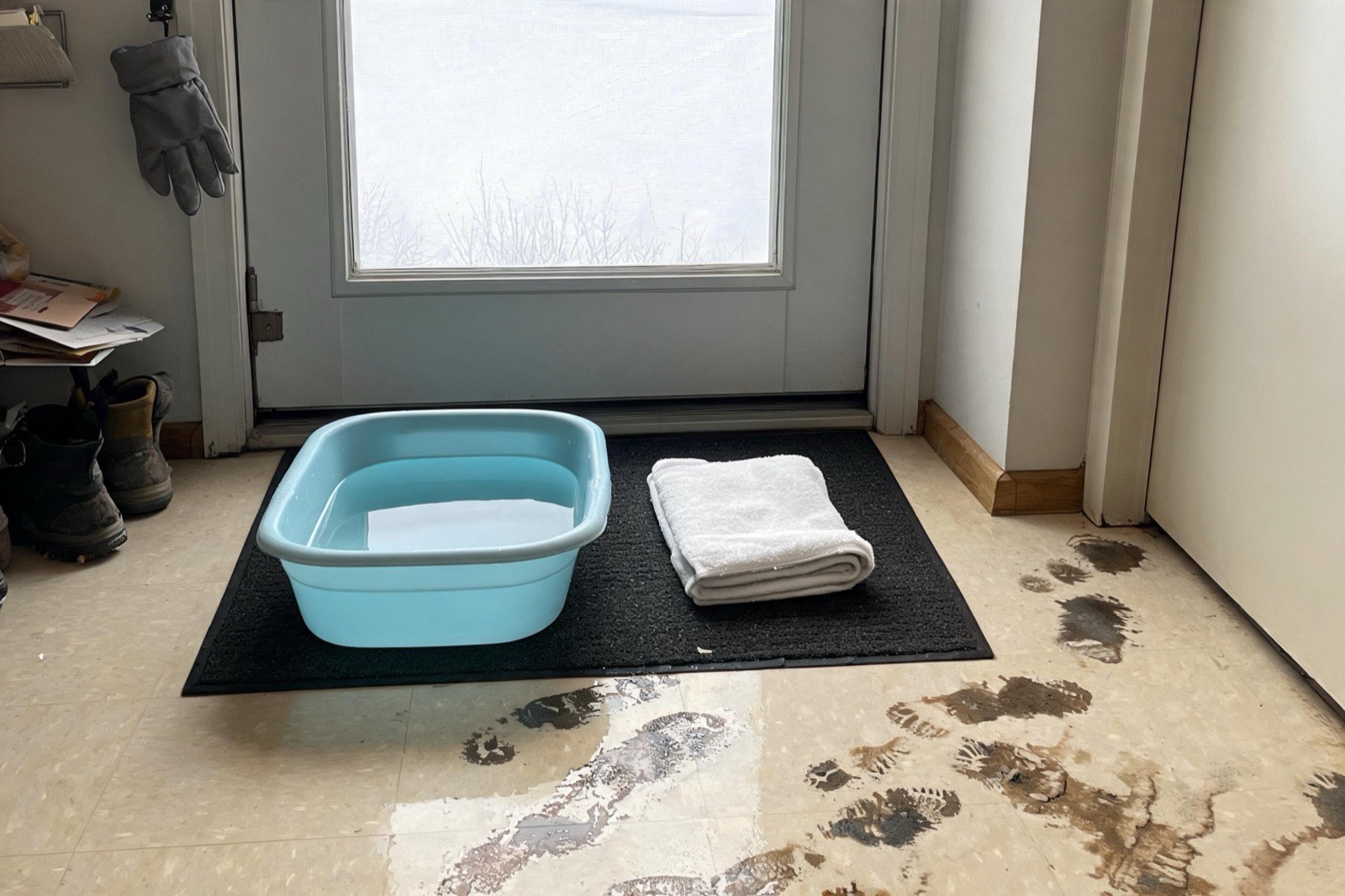
It's a plastic dish tub. December through March it sits inside the back door with two inches of lukewarm water in it. Beside it, cheap bar mop towels. The twenty-four pack, $17.40 last time. You'll go through four a week.
Dunk each foot three or four seconds. While it's under, squeeze the webbing gently between thumb and finger. That's the part everybody skips, because the grit isn't sitting on the bottom of the pad, it's up between the toes. Then dry between the toes. Actually between.
Some dogs won't stand in a tub. Fine. Same job with a soaked towel, slower, works. I did it that way for two winters before Birdie decided the tub was normal.
I also bought one of those cylindrical paw-cleaner cups with the silicone bristles. It holds less water and cleans no better. The bristle noise sent Birdie backwards out of the kitchen four times running.
Balm, honestly
I use balm. I also don't think it does the thing the packaging implies.
Beeswax and petrolatum smeared on before a wet walk is a partial barrier for ten or fifteen minutes, and then it's on the sidewalk. In slush, faster.
Where it earns its keep is afterward, on a foot already rinsed and dried, slowing the overnight moisture loss out of skin that spent an hour in freezing air. That's the whole job. A $22 tin lasts me two winters.
The problem is that dogs eat it. Put it on, then hand over a frozen lick mat, anything that occupies the mouth for ten minutes. Otherwise you've moisturized a tongue.
Boots, and the two weeks nobody budgets for
Boots work.
Boots are also why there's a drawer in my house holding $54.95 of unused rubber, and I know at least six people with the identical drawer.
Dogs hate boots because the pad is a high-input surface. They read grade and texture through their feet constantly, and covering that up is disorienting. The cartoon high-stepping march is a dog trying to feel the ground through something that won't let her. It fades if you refuse to skip ahead.
Sizing first. Stand her on paper with weight on the foot and trace it, then measure the tracing, because a loaded foot spreads wider than one you're holding. Fronts are usually bigger than rears.
Then roughly two weeks. Ours took nineteen days and I still think I rushed the middle.
- Days one and two, the boots just sit on the floor where she eats. Rip the velcro open, cheese, rip it again.
- Day three, one boot on one front foot for ten seconds, then off, then cheese. Ending early is the trick.
- By the weekend she's taking a few steps in that boot for a tossed treat. Say nothing about the high-stepping.
- Second week, both fronts indoors, then all four, short and boring.
- Around day twelve, all four outside on dry pavement. Five minutes. Best walk of her life.
- Then a normal walk.
Two rules matter more than the schedule. End every session while she still looks fine, before she starts shaking a foot. And if you have to drop back a stage, drop back two. A repeated stage costs you a day. A dog who's scared of the boot bag costs you the season.
The marbles between the toes
If your dog grows hair out from between the pads (shepherds, goldens, doodles of every construction) you get a different winter than the short-coated crowd. We drive up to the snow park off 26 a few times a season. This is what ends those trips early.
Snow wicks into that tuft, body heat melts it, and the meltwater refreezes into a hard ball packed between the toes. She goes lame mid-walk and starts chewing at the foot. It looks alarming and it's almost entirely mechanical.
Don't pull the ice ball off. It has hair in it and the hair has skin on the other end. Hold a warm wet cloth against it, or put the foot in the tub and wait a minute. Waiting is miserable when the dog wants it gone right now. Pulling costs you a bleeding foot and a paw she won't let you touch until spring.
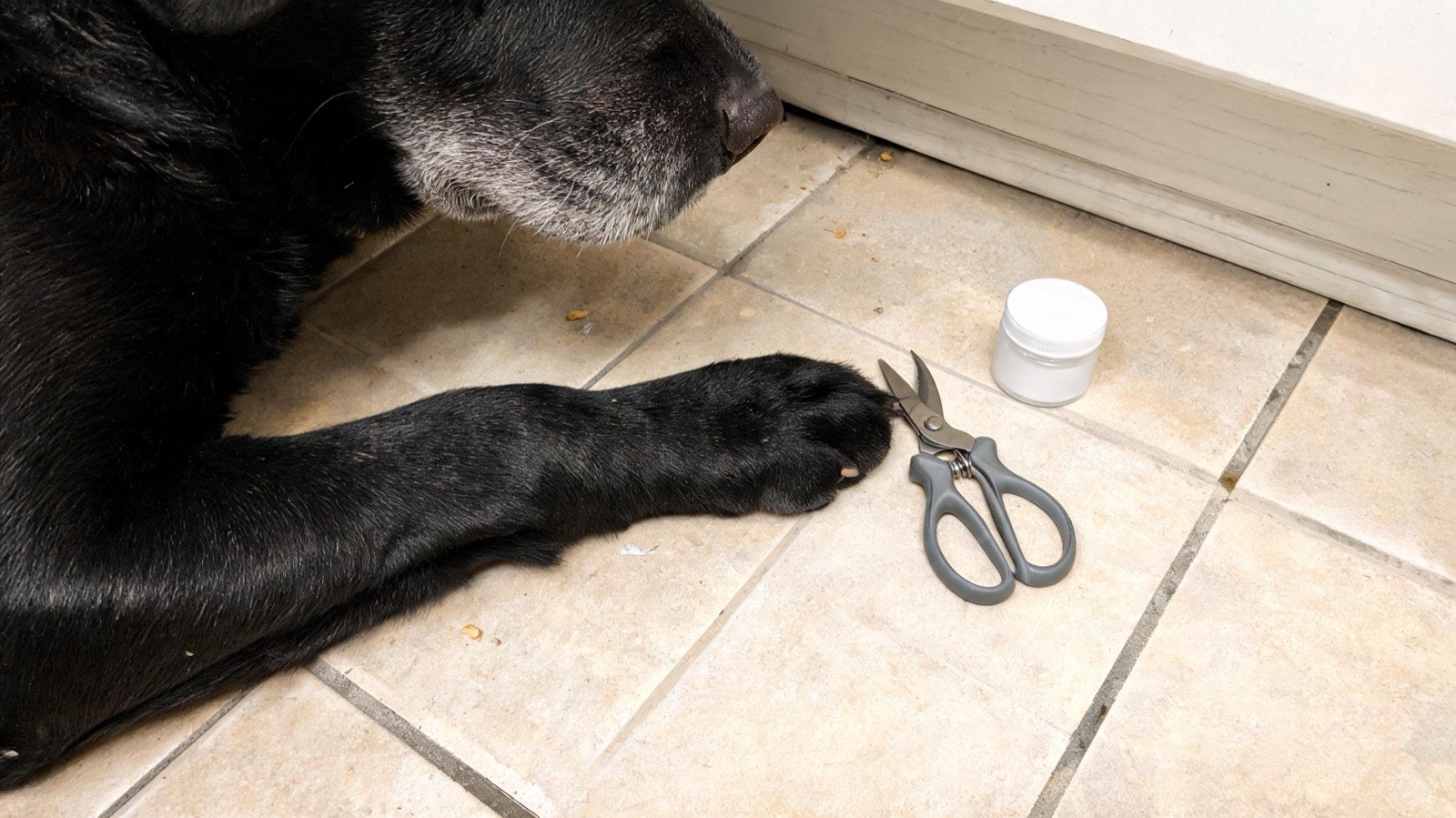
The upstream fix is trimming that tuft flush with the pads so there's nothing for snow to grab. Flush. Do not go down into the webbing. I used blunt-nose scissors the first time and nicked Birdie badly enough that she bled on the kitchen floor. Now it's a small cordless trimmer, the kind groomers use on faces, foot flat in my palm. No blood since, and it helps her traction indoors, which matters if she's already losing her back end on hardwood.
When it stops being a balm problem
Dry, slightly rough pads in February are normal. Chapped is normal. What follows is where I stop being useful and your vet starts.
- A crack that bleeds, or that you can see down into.
- One foot much worse than the other three. Weather hits all four the same; a sliver of glass hits one.
- Swelling, heat, a smell, or wet discharge between the toes.
- Limping that keeps going after the foot is clean and dry.
- Pads and nose thickening at the same time, growing crusty extra tissue at the edges.
- No improvement after ten days of rinsing and drying every night.
The limping one is where I push hardest, especially with older dogs. A leg she's still favoring after the foot has been ruled out may mean a hip. The early signs that are easiest to write off looked a lot like foot soreness in my own house before I knew better.
Two more things I say at work most weeks. Don't put human callus remover on a dog's pad; those acids aren't meant for tissue that gets licked ten minutes later. And if a balm has an ingredient list you can't read, assume your dog eats the whole tin, because sooner or later one of them does.
The tub came up from the basement on the fourth. It'll be in my way every night until March, and last winter I didn't get around to putting it away until May.
Comments
6 commentsRob Kellett · Duluth, MN · Dec 10, 2025
The dish tub. Of course.
Tomas Reinholt · Winnipeg, MB · Dec 14, 2025
Our vet actually told us the opposite on balm - that the pre-walk application is the main event and rinsing after is secondary. She was pretty firm about it. Not saying you are wrong, just that we have done it the other way for three winters and our guy's feet are fine. Maybe it depends what they are putting down where you live? Winnipeg is mostly straight rock salt and sand.
Marta Quinn · Dec 15, 2025
honestly that could easily be a where-you-live thing. straight rock salt on dry cold pavement is exactly the case where pre-walk balm holds up longest, it's slush that strips it off. if it's working, keep doing it. i'd still rinse.
Hollie A. · Erie, PA · Dec 21, 2025
What temperature should the water be? Ours comes out of the tap either scalding or ice.
Marta Quinn · Dec 22, 2025
lukewarm, think bathwater you left sitting too long. cold pads plus hot water hurts, and you get the yelp before you get the clean foot.
Deb Vasquez · Buffalo, NY · Jan 4, 2026
My Moose was a rough collie and his feet were a full time job from November on, enormous tufts, I never trimmed them because a groomer told me the hair was insulation which I now think was nonsense. He would come in and sit down in the entryway and stare at me until I dealt with it. He also would not walk past the Tim Hortons on Elmwood, ever, not once in nine years, we never figured out why and my husband had a whole theory about a delivery truck. We lost him in 2023 and I still buy the towels out of habit. Anyway I read this and thought about him the whole time so thank you for that I guess.
Gwen Pham · Bend, OR · Jan 19, 2026
Which trimmer? I have scissored my dog's foot hair twice and both times ended with me apologizing to her.
Marcus Oyer · Fort Collins, CO · Jan 27, 2026
nineteen days is real. we quit around day six last year and now i get why that didnt work
Comments close after 60 days because we cannot keep up with the spam. Email us instead. We read everything.